

We make decisions as a team every day. Sometimes, things run smoothly. Other times, we wonder why choices don’t lead to the results we expected. The reason often lies in hidden bias traps that shape our thinking—often without us realizing it.
When we talk about bias, we mean mental shortcuts, assumptions, and patterns that influence what gets said, whose opinions are chosen, and how a group moves forward. Left unchecked, these biases can quietly steer teams off course. Here, we share seven bias traps that many teams miss, even when they believe they’re being fair and rational.
Anchoring bias: The first idea sticks
One person shares an idea early in the conversation. Without noticing, the entire discussion orbits around it. Decisions start to align with this first suggestion, even if better options appear later. This is the anchoring bias.
We have seen this in meetings where someone proposes a time for an event, and everyone compares future suggestions to that original time—even if it doesn’t suit the team’s needs. If the anchor is faulty, the outcome suffers.
A study of health information professionals found anchoring bias was one of the most commonly observed phenomena in group settings.
“That first suggestion can feel magnetic—and become hard to leave behind.”
To spot anchoring bias, we encourage questioning every idea as if it came up last in the discussion, not first.
Status quo bias: Sticking with what’s familiar
Teams often prefer the comfort of existing routines. This is the status quo bias: the instinct to keep things as they are, avoiding change even when change might bring improvement.
This shows up when a team keeps using old procedures “because that’s how we’ve always done it,” even if new tools or methods are available. Research on leadership bias reports status quo bias as a top influence on team choices.
Status quo bias can blind us to better solutions simply because new paths seem uncertain or risky.
Groupthink: Harmony replaces honest discussion
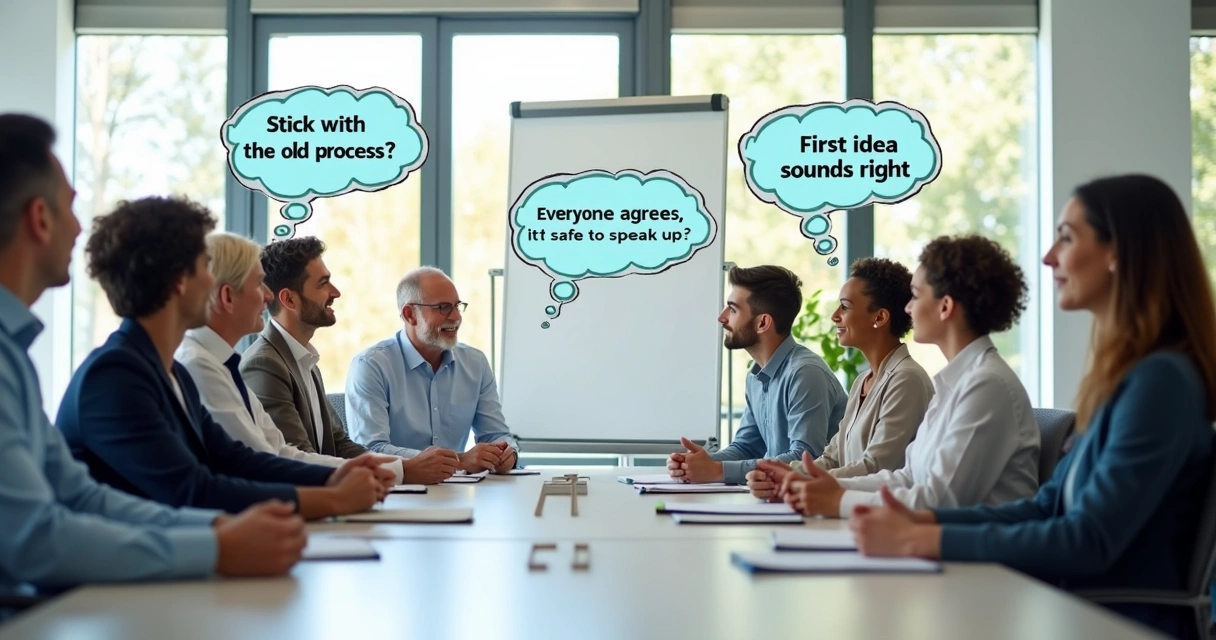
Groupthink is a psychological drive for harmony. In this trap, teams lean toward agreement—even when silent doubts exist. Dissent quietly disappears. The result: quick unity but not always the best answer.
A review of group dynamics highlighted that groupthink flourishes under stress, complexity, or tight deadlines.
We have seen this play out when teams ignore early warning signs because nobody wants to “rock the boat.” Later, someone always wonders why hesitations weren’t voiced.
“When agreement comes too easily, important details go missing.”
The presence of groupthink often hides behind smiles and fast decisions—so we make it a practice to encourage questions, even when everyone nods in agreement.
Authority bias: Trusting the loudest voice in the room
When someone with a senior title or confident manner makes a statement, it can set the course for the whole team. Authority bias is the tendency to give too much weight to opinions from those viewed as leaders or experts—even when everyone else recognizes gaps or mistakes.
In our experience, teams fall into this trap when a respected figure shares an opinion and the room falls quiet, hesitant to challenge. According to the 2007 study of cognitive biases, authority bias shaped 7% of faulty decisions in professional settings.
If a decision relies mostly on who said something, not what was said, authority bias may be guiding the outcome.
Novelty preference: Chasing the newest thing
It’s easy to be drawn toward the newest idea or trend. Novelty preference makes teams think that whatever is new must be better, even without solid evidence. This can pull energy away from proven paths.
The 2025 leadership survey clearly identifies this as a frequent bias, especially in teams aiming to appear innovative.
“We try new things, but sometimes old wisdom gets left behind.”
To balance novelty, we regularly ask: What do we actually know works, and are we ignoring it because something ‘new’ feels more exciting?
Halo and horns effects: Judging the idea by the person
The halo effect means giving extra credit to ideas from a well-liked team member. The horns effect is the opposite: discounting suggestions from someone less favored. Both are shortcuts that tangle up the group’s discussion.
A key finding from the analysis of cognitive bias in teams: the halo/horns effect was visible in how teams weighed input, tending to overlook merit in ideas that came from sources challenging the group’s emotional comfort.
The merit of an idea should always outshine the reputation of its source. We remind ourselves to focus on the proposal, not the messenger.
Sunk cost fallacy: “We’ve already invested so much”
This bias shows up when a team clings to a plan because of time, money, or effort already spent, not because the plan still makes sense. It’s the famous “let’s not waste what we put in, even if continuing might bring more loss.”
The leadership survey on cognitive bias lists the sunk cost fallacy as one of the seven most common traps.
“Invested effort is not a reason to ignore better paths forward.”
It’s worth pausing to ask, “If we were starting from scratch, would we choose this route?”
Confirmation bias: Favoring what fits our beliefs
Confirmation bias is the tendency to notice and support information that matches what we already think, and to downplay or ignore what challenges it. Although often discussed in personal decision-making, it runs strong in teams as well.
A 2014 study on group decision-making showed confirmation bias can affect patient safety—so professional domains are not immune.
We regularly ask ourselves: “Are we looking for reasons to say yes, rather than reasons to test our assumptions?”
Conclusion: Bringing bias into the light
Identifying these hidden bias traps is not about blaming anyone—it’s about gaining awareness. Biases are natural to human thinking. The real risk is when we pretend they don’t exist. By naming and looking out for them, we open doors to better decisions.
When we want better team choices, we look beyond the surface. Even small changes in how we discuss and decide can free us from bias traps and help everyone contribute more honestly.
Frequently asked questions
What are common bias traps in teams?
Teams often miss anchors (giving too much weight to early ideas), status quo (overvaluing current practices), groupthink (avoiding disagreement), authority bias (trusting leaders too much), novelty preference (chasing new trends), halo/horns effect (judging ideas by the person), and sunk cost fallacy (continuing just because of past investment).
How can I spot bias in decisions?
Watch for decisions that happen too quickly or where few voices speak up. If early suggestions drive the whole discussion or if teams stick to tried-and-true methods without review, bias might be at play. Invite questions, silent opinions, and new evidence to shift the conversation.
Why do teams miss certain biases?
Teams miss biases because patterns feel safe, and questioning habits can feel uncomfortable. Many biases work quietly, blending into normal team routines, especially when decisions are made under stress or time pressure.
How to avoid bias traps at work?
Encourage team members to discuss their first impressions and openly challenge any prevailing views. Rotate who speaks first, try structured check-ins on team opinions, and often ask: “What might we be missing?” or “Is there a different way to see this?”
What is confirmation bias in teams?
Confirmation bias causes teams to search out opinions and data that fit what they already believe, while ignoring what clashes. This makes it harder to change direction or notice warning signs. Asking for opposing views can help reduce its effects.